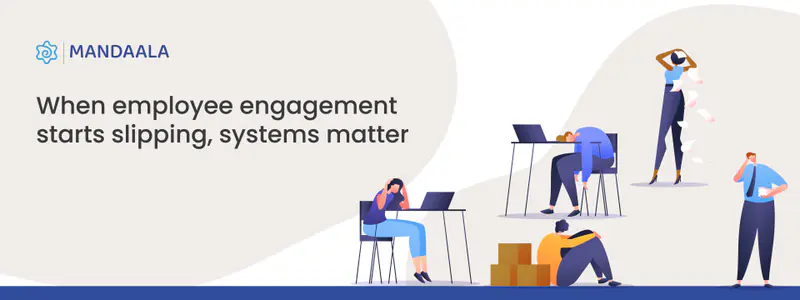
A drop from 24% to 19% may not sound dramatic. But in the world of employee engagement, it’s a big deal.
In 2025, employee engagement in India declined even as global engagement reached its highest level in a decade. That makes India an outlier, and not in a good way.
Because when workplace engagement starts lagging behind, it doesn’t just affect morale. It affects how teams collaborate, how managers lead, and how company culture shows up in everyday work.
What a drop in employee engagement actually signals
Think of employee engagement as willingness, not mood. When that willingness fades, the signals are easy to spot:
Work gets done, but the extra 10% disappears
Managers follow up more than they coach
Teams feel less connected, affecting workplace engagement
Growth and internal movement slow down
Recognition becomes inconsistent, impacting employee satisfaction
In a context where employee engagement in India is already low and falling faster than global trends, these aren’t minor shifts. They’re early warnings.
Why retaining engagement is getting harder for companies

Most organisations already know the usual levers of employee engagement: pay, perks, growth, culture. The problem is the workplace has changed faster than the systems and budgets meant to support workplace engagement.
Manager load is heavy, and it shows up everywhere
Engagement is often won or lost at the manager level, but overloaded managers default to delivery because they’re stretched on time and headcount. Coaching, context-setting, and recognition become “nice to have”, which weakens employee experience quickly.
Hybrid work made belonging harder to maintain
Hybrid work removed many of the everyday moments that built trust for free, like informal feedback and casual recognition. Replacing those moments takes planning and effort, which often gets deprioritised when budgets and bandwidth are tight, thinning workplace engagement.
Growth expectations have become sharper
Employees expect growth that feels tangible, but learning, mobility, and development budgets haven’t grown at the same pace as expectations. When progress feels vague or delayed, employee satisfaction drops fast, especially for early-career talent.
Recognition is inconsistent, and inconsistency is the killer
Recognition is still treated as an annual event, a manager’s personal style, or whatever budget is left over. That inconsistency makes it unclear what effort gets noticed, and when appreciation feels rationed, employee engagement suffers.
Too many programs, too little operational muscle
Engagement programs are expected to do more with limited budgets, but without strong systems, money gets lost in inefficiency. Approvals slow things down, vendors vary, data keeps changing, and workforce engagement becomes hard to sustain, regardless of company culture.
The intent is good. The system is missing.
Employee engagement strategies that actually hold up in the Indian context

There is no single “program” that fixes employee engagement. The strongest approach to improving workplace engagement is a stack of habits and systems that reinforce each other and hold up in day-to-day employee experience.
1. Build manager rhythm, then protect it
If you want employee engagement to rise, make it easy for managers to do the basics well:
weekly 1:1s that include growth, not just tasks
clear expectations and priorities
short feedback loops
simple ways to recognise effort publicly and privately
A small operational shift here often does more for workforce engagement and employee satisfaction than a big culture campaign.
2. Treat listening as a loop, not a survey
Surveys are fine. What employees trust is the loop:
you asked
you acted
you updated people on what changed
you repeated
Even if you cannot act on everything, showing the decision process builds credibility and strengthens employee experience and organisational culture.
3. Make growth visible
“Learning resources” are not a growth strategy on their own, especially in the Indian workplace.
What helps more:
internal role pathways that are easy to understand
project marketplaces or stretch assignments
mentorship that is structured enough to sustain
recognition tied to skills and craft, not just outcomes
When growth is visible, employee satisfaction and long-term employee engagement tend to follow.
4. Strengthen belonging with repeatable rituals
Belonging is built through repeated signals, not one-off initiatives:
onboarding that feels personal
team identity and shared milestones
cross-functional showcases
rituals that work across locations, not only in HQ
This matters in India because teams are often distributed across cities, sites, and client locations, making workplace culture harder to sustain without intention.
5. Make recognition frequent, specific, and fair
Recognition supports employee engagement when it is:
timely
specific about what was valued
connected to team or company culture
visible enough to set standards
fair across roles and regions
When these practices are in place, engagement doesn’t need constant fixing. It holds because people know what’s expected, what’s valued, and how they grow here. That clarity does more for employee engagement than any one-off initiative ever will.
Employee engagement, made tangible through merchandise
Two numbers say a lot about where employee engagement is headed next:
The global corporate gifting market is expected to cross $1.2 trillion by 2029.
In India, corporate gifting is projected to grow by around 50% over the next five years.
That kind of growth isn’t about more stuff. It’s about companies leaning into tangible ways to make work feel more human, more memorable, and easier to stay connected to.
This is where merchandise fits in.
Recognition becomes visible.
A welcome kit, milestone gift, or service award gives effort a physical marker. It lands differently than an email and sticks longer in the employee experience.
Belonging becomes repeatable.
The same moments can show up across teams and locations, not just in one office, which helps workplace engagement hold up in distributed setups.
Culture becomes something people can hold.
Company culture moves out of slides and slogans and into everyday work through things people actually use.
Seen this way, merchandise isn’t a nice extra. It’s one of the simpler ways companies are trying to hold employee engagement together as the way we work keeps shifting.
Making employee engagement easier to sustain with MerchTech

Merchandise supports employee engagement best when there’s a single digital platform quietly holding it all together. That way, teams aren’t starting from scratch every time or fixing gaps after things go out.
A central catalogue with consistent branding lives in one place, so quality and identity stay aligned across teams and locations.
HRMS-linked automation keeps employee details updated and triggers onboarding kits, milestones, and service awards without manual tracking.
Employee self-service lets people handle sizes or choices themselves, cutting down coordination.
Built-in updates and notifications keep employees informed without constant follow-ups.
Tracking, dashboards, and reports make it easy to see what’s been sent, delivered, and still in motion.
Feedback loops help teams understand what’s landing well and fine-tune over time.
With a digital system doing the background work, merchandise becomes a steady, low-effort way to support employee engagement, instead of something that depends on chasing and coordination.
Conclusion: What it really takes to hold employee engagement steady
If you want engagement to hold, you need two things at the same time:
Human strategy: managers, growth, belonging, recognition
Operational system: workflows, controls, visibility, scale
Merchandise programmes sit nicely in the middle because they are human in impact and operational in execution.
In a year where India’s engagement has dipped, the companies that stabilise it will be the ones that stop treating engagement as “more initiatives” and start treating it as “better systems for consistent moments”.
If you’re thinking through how to make this easier in your own team, we’re always up for a quick conversation.
Mandaala is the solutions arm of PrintStop India