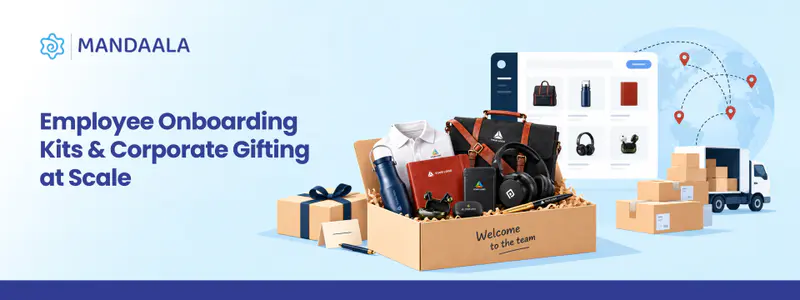
Corporate gifting has grown. Have the processes kept up?
Employee onboarding kits, festive gifting and recognition programs have become recurring responsibilities for many HR and Admin teams. Yet the processes supporting them often remain surprisingly manual, with spreadsheets, email approvals and separate vendors handling different stages of the same requirement.
As organisations expand across locations, changing employee information, customisation requirements, approvals and deliveries make these programs harder to coordinate.
Managing employee onboarding kits and corporate gifting at scale requires centralised budgets, approved merchandise, automated ordering and coordinated fulfilment. But getting there starts with understanding where the existing process tends to fall apart.
Why Is Managing Employee Onboarding Kits and Corporate Gifting So Challenging?

The biggest challenge in managing employee onboarding kits and corporate gifting at scale is the number of dependencies involved. A delay in sourcing, an outdated employee record or a missed approval can affect production and delivery. These problems become harder to resolve when different teams and vendors manage different stages.
Here's where HR and Admin teams tend to feel the pressure.
1. Too Many Vendors to Coordinate
A single onboarding kit might include apparel, stationery, drinkware and tech accessories. Sounds straightforward, until each product comes from a different supplier with its own pricing, branding requirements and production timelines.
Someone still has to bring it all together, often while managing several other employee requirements.
2. Employee Details That Keep Changing
Joining dates get pushed, employees relocate and delivery addresses change. That's part of everyday HR operations.
The trouble begins when every update has to travel through spreadsheets, emails and multiple vendors before reaching the right person. A small change in employee information can mean revisiting an order that has already been approved.
3. Customisation Comes with More Decisions
Not every employee receives the same kit, and not every occasion has the same budget.
Product variations, branding requirements and approval hierarchies add decisions to what might otherwise be a routine order. Without a defined process, even minor changes can hold things up.
4. One Program, Hundreds of Delivery Addresses
Sending 500 kits to one office is very different from delivering 500 personalised kits to employees across the country.
Each order has its own address, dispatch timeline and tracking requirements. A missed update or failed delivery can quickly become another task for HR to resolve.
5. Limited Visibility into Order Status
The products have been approved. Production is underway. But has the kit been dispatched? And who has the tracking details?
When different teams manage different stages, answering a simple employee query can involve several rounds of follow-ups.
What makes these challenges particularly difficult is how easily one can affect another. A delayed approval pushes back production, while an outdated address can undo an otherwise well-planned delivery.
Handling each issue separately might solve the immediate problem. Managing them consistently across hundreds or thousands of employees requires a different approach.
How Should Enterprises Structure Their Onboarding and Corporate Gifting Programs?

Enterprises can manage onboarding and corporate gifting more effectively by establishing common standards for budgets, merchandise and approvals while allowing different programs to follow workflows suited to their requirements.
The objective isn't to make every gifting program identical. It's to avoid rebuilding the entire process whenever a new requirement comes up.
1. Centralise Standards, Allow Local Decisions
Centralising every merchandise request can slow down regional teams. But allowing each office to source independently can create inconsistencies in pricing, branding and quality.
A better approach is to establish common standards while giving teams room to make relevant decisions.
Central teams: Define budgets, approved merchandise catalogues, branding guidelines and supplier standards.
Regional teams: Select products from the approved range based on local preferences, employee requirements and delivery conditions.
Approval workflows: Allow orders within predefined limits to proceed without repeated approvals, while routing exceptions for review.
This gives regional HR and Admin teams the flexibility to manage their requirements while maintaining organisation-wide oversight.
2. Decide When to Standardise and When to Offer Employee Choice
Standardisation works when employees need the same essentials. Employee choice makes more sense when personal preferences influence how useful or meaningful a gift will be.
Fixed kits: Use standard configurations for onboarding essentials and mandatory materials.
Curated choice: Offer an approved selection for festive gifting, lifestyle merchandise and long-service recognition.
Budget consistency: Keep options within a defined value range, even when employees select different products.
Selection deadlines: Set response windows and fallback options so unanswered selections don't delay fulfilment.
Consider a five-year service award. Instead of selecting one gift for everyone, an organisation can offer several products of comparable value.
The company still decides the budget and product range. Employees simply choose what suits them.
3. Build Recurring Orders into the Process
For organisations with regular joining cycles or employee recognition milestones, every order shouldn't require a fresh request.
A recurring-order process can establish when merchandise is needed, what employees are eligible to receive and who is responsible for exceptions.
Joining-based requests: Initiate onboarding kit orders when employee joining details are confirmed.
Milestone-based requests: Schedule recognition gifts around service anniversaries or other eligibility criteria.
Pre-approved configurations: Reuse established merchandise selections and budget rules.
Exception handling: Assign responsibility for postponed joining dates, incomplete information and changes to existing requests.
This allows routine requirements to follow a predictable process while leaving room for requests that need individual attention.
4. Use Different Workflows for Different Gifting Programs
Onboarding, recognition and festive gifting may share merchandise resources, but they don't follow the same schedule or have the same measures of success.
A common set of standards can support all three. What changes is how the program begins, how employees participate and what teams need to track.
Once these decisions are clear, it's easier to avoid the planning mistakes that make large-scale gifting unnecessarily complicated.
What Are the Most Common Mistakes in Corporate Gifting at Scale?
Some corporate gifting challenges are unavoidable. Poor planning doesn't have to be one of them.
The most common mistakes often happen before the first order is placed, when decisions about budgets, products, timelines and responsibilities are made without considering the full program.
These mistakes have something in common: they make routine requirements unnecessarily difficult to repeat.
Clear requirements, realistic timelines and defined responsibilities make a difference. So does selecting merchandise that suits the occasion, the employee and the practical requirements of fulfilment.
What Should Companies Include in Employee Onboarding Kits, Recognition Gifts and Festive Hampers?

Employee onboarding kits typically combine work essentials, branded merchandise and a personal welcome. Recognition gifts may include commemorative awards or premium lifestyle products, while festive hampers can bring together useful products suited to the occasion.
There isn't one assortment that works for every program. The employee's needs, the purpose of the gift and the delivery requirements should all influence the selection.
1. Employee Onboarding Kits: Start with the Employee's Workday
An onboarding kit should help a new joiner feel prepared, not just welcomed. That makes the employee's role and working arrangement a sensible starting point.
For getting started: ID cards, access badges, welcome letters and other joining essentials.
For everyday use: Backpacks, notebooks, drinkware, laptop sleeves and desk accessories.
For a personal welcome: A team note or an item customised with the employee's name.
A fixed kit may work for employees in similar roles. But someone working remotely and someone based in the field won't necessarily use the same products.
A core kit with a few role-specific additions is often more practical than either a completely standard box or an entirely customised one.
2. Recognition Gifts: Consider What the Employee Is Being Recognised For
The significance of the achievement should influence the gift.
A performance award might call for a personalised trophy or plaque, while a long-service milestone could warrant something more substantial.
Long-service recognition: Luggage, watches, premium lifestyle products or an approved selection of gifts.
Individual achievements: Trophies, plaques and commemorative merchandise featuring the employee's name or achievement.
Team milestones: Shared keepsakes or merchandise marking the accomplishment.
For higher-value awards, employee choice can be particularly useful.
Rather than assuming everyone wants the same premium product, organisations can offer several options within the allocated budget. A commemorative award can still accompany the selected gift.
3. Festive Hampers: Choose Products That Work Well Together
Festive hampers don't have to follow the familiar sweets-and-décor combination.
Tech accessories, desk essentials and lifestyle products can make equally relevant gifts, provided the assortment feels considered.
Some combinations worth exploring include:
A workday hamper: Wireless charger, desk organiser and insulated drinkware.
A travel hamper: Power bank, travel organiser and compact accessories.
A festive hamper: Gourmet treats, a handcrafted product and a useful home accessory.
These aren't fixed templates. They illustrate how a shared purpose can make a hamper more cohesive than an assortment of unrelated products.
For large-scale gifting, product compatibility, shelf life, packaging and delivery conditions should also influence the selection.
4. Physical Merchandise or Gift Cards?
Physical gifts suit occasions where a tangible product or personalised keepsake matters.
Gift cards are useful when preferences vary widely, particularly across large or geographically dispersed employee groups.
A combination can work too. A long-service award might include a personalised memento alongside a gift card.
Whichever route the organisation takes, four checks are worth making before finalising the merchandise:
Total cost: Include branding, packaging, taxes and delivery.
Product quality: Review samples and consistency across batches.
Recipient suitability: Consider sizes, preferences and regional requirements.
Fulfilment: Check product availability, customisation timelines and shipping restrictions.
Merchandise selection is only part of the job. The products chosen determine how much customisation, assembly and delivery coordination the program will require.
And at enterprise scale, those details matter just as much as the products themselves.
How Can Companies Manage Corporate Merchandise Production and Fulfilment at Scale?
Managing corporate merchandise fulfilment at scale means getting the right products, with the right branding, to employees on time.
For large onboarding and gifting programs, that requires coordination across production, quality checks, assembly, delivery and exception handling.
1. Production and Customisation
Before production begins, confirm product quantities, branding specifications and delivery deadlines.
Approved samples help maintain consistency, while retaining artwork and specifications makes repeat orders simpler.
This becomes particularly useful when the same merchandise is required across different employee groups or locations.
2. Quality Checks and Kit Assembly
Check products and branding before assembly, when errors are easier to correct.
Packing lists help teams manage different kit combinations and match personalised items to the right employees.
For programs involving multiple product variations, a consistent assembly process also reduces the risk of incorrect or incomplete kits.
3. Multi-location Delivery
Employee gifts may need to reach offices, homes or international locations.
Verify addresses, plan dispatch around joining dates and celebrations, and account for longer transit times or customs requirements.
A delivery schedule should reflect where recipients are located, rather than assuming every shipment will follow the same timeline.
4. Returns and Delivery Exceptions
Even with careful planning, products can arrive damaged, shipments can fail and orders can change.
A clear process for tracking issues, assigning responsibility and arranging replacements helps prevent individual problems from affecting the wider campaign.
For recurring programs, these activities become easier to coordinate when the people handling them have access to accurate order information and delivery updates.
That is where technology starts to make a practical difference.
How Does Technology Support Employee Onboarding and Corporate Gifting at Scale?
Technology helps enterprises manage employee gifting by connecting employee information, merchandise selection, ordering, approvals and tracking through shared systems.
The value lies less in digitising individual tasks and more in reducing the manual work involved in moving information between them.
1. Connect Existing Systems Through Integrations
Employee gifting often depends on information already available in HR and other enterprise systems.
Integrations allow that information to support merchandise ordering without maintaining separate records for every campaign.
HRMS and API integrations: Employee details and eligibility information can flow into the merchandise platform, with changes reflected in pending orders where supported.
Rewards and recognition platforms: Recorded milestones can initiate gifting requests without separate submissions.
Single sign-on (SSO): Employees can access the merchandise portal through their organisation's existing login.
An important consideration is whether these connections support updates as well as new requests.
An integration that creates an onboarding kit order but cannot account for a postponed joining date still leaves work for HR.
Employee information also needs to be handled securely, with appropriate access controls and policies for sharing, retention and deletion.
2. Bring Merchandise Selection and Ordering Online
An employee-facing merchandise portal provides a common place to browse approved products, make selections and submit orders.
Digital catalogues: Display products, available variants, branding options and location-specific availability.
Self-service ordering: Allow employees to choose merchandise and confirm delivery information.
Order records: Capture selections, quantities and recipient details in a consistent format.
This is especially useful for programs that offer employee choice.
Rather than collecting individual preferences through forms and emails, organisations can present an approved selection and let employees choose within the defined budget.
For administrators, orders arrive through a consistent process, with fewer details to collect manually.
3. Automate Approvals and Order Progression
An order may pass through several teams before it reaches production.
Workflow automation helps move requests through these stages while keeping outstanding actions visible.
Workflow routing: Direct requests through the required checks and approvals.
Status updates: Record when an order has been confirmed, sent for production or handed over for dispatch.
Exception alerts: Flag incomplete requests, unavailable merchandise or orders that have stopped progressing.
This becomes particularly useful when different departments and locations are placing orders simultaneously.
Teams can identify where attention is needed without reviewing every request individually.
4. Use Reporting to Understand the Entire Program
Individual order tracking answers a simple question: where is this gift?
Enterprise reporting answers a broader one: how is the program performing?
Operational dashboards: Show pending orders, outstanding actions and delivery status across locations.
Spending reports: Consolidate merchandise costs by department, occasion or employee group.
Program analytics: Compare participation, product preferences and fulfilment performance across campaigns.
These insights can inform future budgets, merchandise selection and campaign timelines.
If deliveries to certain locations are frequently delayed or particular products generate more replacements, those patterns can help teams make better decisions for the next program.
Of course, technology alone doesn't produce or deliver a gift. It helps the teams involved work from the same information, while merchandise and fulfilment determine what employees actually receive.
How Do Merchandise, Technology and Fulfilment Work Together?
An integrated employee gifting approach brings together three capabilities: merchandise to meet the gifting requirement, technology to manage orders and information, and fulfilment to prepare and deliver the products.
Consider an employee onboarding program.
Once a new joiner's details are confirmed in the HRMS, a kit request can be initiated based on the organisation's approved merchandise and eligibility rules.
The order moves through the required checks, the kit is prepared and delivery is coordinated around the joining date. HR can follow its progress without managing every handover individually.
If the joining date changes or the delivery address needs updating, the team can identify the affected order and take action before dispatch, subject to the workflow and production stage.
The same operating model can support recognition awards and festive gifting, even when product choices, recipients and timelines differ.
Mandaala is an enterprise gifting and merchandise management solution that brings merchandise, technology and fulfilment together through its MerchTech approach. MerchTech connects product selection, ordering and fulfilment so organisations can manage recurring gifting requirements through a coordinated process.
What that looks like in practice varies considerably between organisations. Some need faster onboarding kit dispatch. Others want to eliminate office inventory, introduce employee choice or manage personalised gifting across locations.
The following programs illustrate those differences.
How Have Companies Managed Employee Onboarding Kits at Scale?

Enterprise onboarding programs don't all face the same challenges.
The following Mandaala case studies show how different organisations have approached ordering, personalisation, inventory and fulfilment.
1. Kotak Mahindra Bank: Automating Onboarding Kit Orders
Challenge: Managing onboarding kits across employee grades and locations required considerable manual coordination from HR teams.
Approach: Kit ordering was integrated with the HRMS, allowing requests to be initiated automatically. Merchandise was assigned according to employee grade and delivered directly to new joiners.
Outcome: Onboarding kits were dispatched within 48 hours.
Read the Kotak Mahindra Bank case study
2. JLL: Delivering Onboarding Kits Without Office Inventory
Challenge: Storing kits at offices and distributing them manually made it difficult to reach employees joining at client sites and other locations.
Approach: Weekly joining data was used to prepare and deliver kits directly to employees, removing the need for office-level inventory.
Outcome: The program achieved 100% kit delivery without requiring office storage.
Explore the JLL onboarding case study
3. A Global Professional Services Firm: Sustainable Onboarding Kits with Employee Choice
Challenge: The firm wanted its welcome kits to reflect its sustainability priorities while giving new joiners a choice of merchandise.
Approach: Employees could select from three curated kits through a digital redemption portal. The options included sustainable products such as cork diaries and seed pens.
Outcome:25,000 kits were managed between August 2023 and February 2025, with 100% redemption.
Explore the onboarding kit program
4. A Global Software and Digital Solutions Provider: Personalised Pre-joining Kits
Challenge: Coordinating multiple vendors and tracking orders manually made personalised pre-joining gifting difficult to manage.
Approach: A digital portal allowed candidates to build their own welcome kits by selecting products from four categories: Care, Wellness, Celebration and Utility.
Outcome: The program recorded 60% higher pre-joiner engagement, while reducing manual follow-ups.
Read the personalised onboarding case study
A solution that works for occasional bulk gifting may not be suited to a company managing new joiners every week or running several employee gifting programs simultaneously.
That makes the choice of gifting partner just as important as the merchandise itself.
How Can Companies Choose the Right Enterprise Corporate Gifting Partner?
Choosing an enterprise corporate gifting partner involves more than comparing merchandise catalogues and prices.
Companies should consider experience with similar programs, accountability, flexibility, total costs and delivery performance.
The right partner should be able to manage changing requirements across employee groups and locations without creating additional work for HR, Admin or Procurement teams.
1. Experience with Similar Corporate Gifting Programs
A familiar client name doesn't tell you much about the work involved.
Look for case studies covering similar employee volumes, order frequency and delivery locations. Pay attention to what the partner actually managed and the results they achieved.
A company handling monthly onboarding requirements may need different capabilities from one organising a single annual festive campaign.
2. Clear Accountability for Orders and Deliveries
When an order is delayed, a product needs replacing or a shipment goes missing, who handles it?
Find out whether your team has one point of contact and how issues are resolved without repeated follow-ups.
Clear responsibility matters particularly when merchandise sourcing, production and delivery involve different teams.
3. Flexibility Across Employee Gifting Requirements
Onboarding kits, employee recognition gifts and festive hampers don't follow the same schedule or budget.
Check whether the partner can accommodate changes in merchandise, recipient numbers and delivery locations, and what those changes might cost.
It's also worth understanding how repeat orders, employee choice and last-minute changes are handled.
4. Transparent Corporate Gifting Costs
Compare the total cost of the program rather than merchandise prices alone.
Branding, packaging, storage, shipping, returns and platform fees can all affect the final amount.
Minimum order quantities and unused inventory should also be considered, especially for recurring programs where demand may change throughout the year.
5. Proven Delivery Performance
Delivery promises are useful, but actual results offer a better basis for comparison.
Ask for dispatch timelines, delivery success rates and examples of how the partner handled delays or large, time-sensitive orders.
For multi-location programs, understand how delivery tracking, exceptions and replacements are managed.
Ultimately, the evaluation should help an organisation understand not just what a partner can supply, but how reliably it can support the entire program as requirements grow.
Conclusion
A corporate gifting program should be able to grow without demanding more time and attention from the teams running it.
That means planning for recurring orders, changing employee requirements and the occasional last-minute request, rather than treating every gifting occasion as a fresh project.
Clear processes make individual tasks easier to manage. Connecting merchandise, technology and fulfilment makes those processes easier to repeat across employees, locations and occasions.
With Mandaala's MerchTech approach, organisations can manage these requirements through a connected enterprise gifting solution, while giving HR, Admin and Procurement teams greater visibility into the programs they're responsible for.
Planning an employee onboarding or corporate gifting program? Talk to our team about managing it at scale.
Mandaala is the solutions arm of PrintStop India.