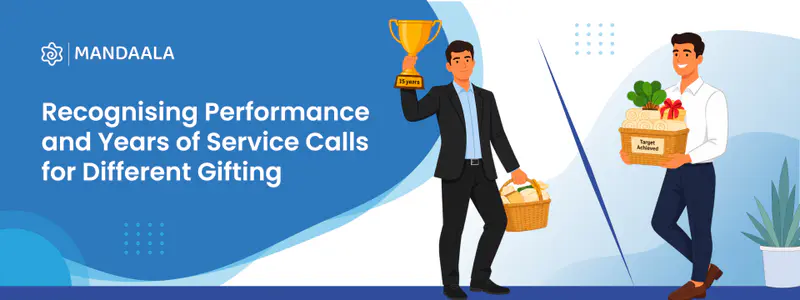
The same gift can mean very different things depending on why you’re giving it.
An exceptional project win and ten years with an organisation are both moments worth recognising, but they’re not the same kind of recognition. Merit-based employee gifting celebrates an achievement; tenure-based gifting marks a service milestone. So the way you approach the gift should change too, from what you give and how much you spend to employee choice, personalisation and even how the gift is presented.
And getting those details right matters. Research from Gallup and Workhuman found that employees who received high-quality recognition were 45% less likely to have changed organisations two years later, with personalisation among the five pillars of high-quality recognition.
So rather than asking whether merit or tenure is the better model, it’s more useful to ask: how should you approach each differently?
Merit-based vs tenure-based employee gifting: What sets them apart?
Before getting into how you approach each, here’s the basic difference.
Merit-based employee gifting:
Recognition triggered by a specific achievement, contribution or performance milestone.
Tenure-based employee gifting:
Recognition triggered when an employee reaches a defined length-of-service milestone.
The distinction is fairly simple. What you’re recognising changes, so the way you gift should change with it.
How should you approach merit-based employee gifting?

Merit-based gifting is a little less predictable. The recognition could be for a major project win, an innovative idea, exceptional performance or something the employee did particularly well. So the gift needs to make sense for the achievement, not just the fact that an award was given.
Decide what different achievements are worth: Not every contribution needs the same level of reward. A few clear award tiers or categories can help set budgets and keep recognition consistent across teams without creating a separate rule for every possible achievement.
Curate products around the reward level: Once the budget is clear, think about what actually belongs in each range. Branded merchandise or everyday lifestyle products may work for one level, while electronics, travel products or more premium gifts could sit in another.
Give employees some choice: Two people receiving the same award can still have completely different preferences. A curated gift catalogue gives them enough room to choose something they’ll use, while keeping the options relevant to the reward.
Keep the gift close to the win: If someone is being recognised for a project they just delivered, a gift arriving three months later is going to feel a little disconnected from it. Product availability, customisation and fulfilment all need to move quickly enough for the recognition to still feel current.
Personalise where it makes sense: A name, award category, achievement or short message can connect the physical gift back to why the employee is receiving it. It doesn’t need branding on every surface to feel specific to the occasion.
There’s good reason to be thoughtful about what earns recognition too. Gallup research on authentic employee recognition found that employees who strongly agreed their recognition was authentic were five times as likely to strongly agree that recognition was distributed equitably according to performance.
For merit-based employee gifting, the reward should make sense in the context of the achievement. A small contribution and a major business win don’t necessarily need the same recognition experience.
How should you approach tenure-based employee gifting?

Tenure-based gifting gives you something merit-based gifting often doesn’t: time to plan. You already know when someone is going to complete 3, 5 or 10 years. The bigger question is how to stop a long service award from becoming the same exercise repeated every few years.
Make the milestones feel different: A 3-year gift and a 10-year gift shouldn’t feel interchangeable. The budget might increase, but the difference can also come through in the product range, personalisation, presentation or the way the milestone is celebrated.
Curate for the milestone, not just the price: Lifestyle products, electronics, travel products, premium merchandise and other higher-value gifts can all work across different service tiers. Look at what feels appropriate for that stage rather than simply adding a higher price tag each time.
Keep commemorative gifts as an option: Plaques, trophies, engraved awards and personalised mementoes still make sense for long service recognition, particularly at bigger milestones. They don’t have to replace a more functional gift either. An employee could receive something commemorative alongside a product they’ve chosen.
Give people a say in what they receive: Ten employees completing five years have one thing in common: they’ve completed five years. Their tastes may have very little else in common. A curated gift catalogue lets people choose while keeping the budget and product range appropriate for the milestone.
Use the lead time for personalisation: Names, years of service, a short message, customised products or packaging can make the gift specific to the employee. Since these milestones are known in advance, there’s more opportunity to plan those details properly.
With long service awards, progression doesn’t have to mean simply spending more each time. The 5-year, 10-year and 15-year experiences can each have their own character.
Can merit-based and tenure-based gifting work together?
Yes. Someone could receive a merit award for a major project in March and complete ten years with the organisation six months later. There’s no overlap in what those two moments are recognising, so both can comfortably sit within the same employee recognition program.
They just don’t need to follow exactly the same route.
Be clear about what triggers each: Merit recognition might begin with a manager nomination or an award through the R&R platform. Tenure is more straightforward because the service milestone already exists in your HRMS. Both can feed into the same gifting program from different starting points.
Keep the reward structure manageable: Merit doesn’t need a new tier for every possible achievement. A few levels can cover similar awards, while tenure can have its own progression based on years of service. That gives both programs some structure without turning them into a maze of budgets and rules.
Let product ranges overlap where it makes sense: You don’t need a completely new catalogue for every award. Some products may work across merit and tenure, while premium or commemorative options can sit within particular reward levels or service milestones.
Plan differently for predictable and unpredictable recognition: You can see a 10-year service anniversary coming. A standout performance next Thursday is harder to forecast. That difference should feed into how you plan product availability, customisation and fulfilment.
Both can run through the same employee gifting program. What changes is the logic behind the gift: why it was triggered, what the employee can choose and how quickly it needs to reach them.
What do employee recognition programs often get wrong?
Even with the structure sorted, there are a few ways employee recognition can lose some of its meaning.
Making every achievement feel equally big: If every contribution leads to the same employee recognition gift, the bigger wins eventually stop standing out. Be clear about which achievements warrant a gift, which deserve a higher level of reward and which might be better recognised in another way.
Letting the gift arrive without the recognition: A parcel turning up at someone’s home isn’t quite the same as being recognised. For merit-based gifting, connect the gift to the manager conversation, announcement or award. For long service awards, make sure the employee knows what the milestone itself means to the organisation.
Planning for the office and figuring out everyone else later: Remote employees, hybrid teams and people spread across locations need to be part of the plan from the beginning. How will they access the catalogue, make a selection and receive the physical gift?
Spending more without looking closely at the product: A higher budget doesn’t automatically make a better gift. Quality, usefulness, customisation and presentation all influence how an employee recognition gift actually feels when it arrives.
Ignoring what employees choose: If employees are choosing their own gifts, their selections tell you something. Redemption rates, popular categories and products that rarely get picked can all help shape the next round of employee milestone gifts and merit rewards.
A recognition program can be beautifully organised behind the scenes and still fall flat for the employee. Ultimately, they’re experiencing the recognition and the gift, not the process used to get it there.
How do you manage employee recognition gifting at scale?

Once you have hundreds or thousands of employees across locations, there’s a lot happening between deciding someone should receive a gift and that gift actually reaching them. Technology can take care of some of it, but there’s still a physical product that needs to be sourced, customised, packed and delivered.
That’s why a few practical decisions start to matter more as the program grows.
Plan the product range with the program: Map products to merit bands and service milestones early. Look at budgets, stock availability, lead times, customisation and possible substitutes alongside the product itself. A great option isn’t particularly useful if it won’t be available when people need to order it.
Connect the systems already holding the information: An HRMS already knows when someone reaches a service milestone. An R&R platform may already hold merit recognition data. Integrations can move that information into the gifting process without HR maintaining another set of trackers. This is where automated employee gifting can take some repetitive admin out of the picture.
Keep the choice curated: More choice isn’t automatically better choice. A considered range within each budget or milestone gives employees enough variety without creating hundreds of product and fulfilment combinations behind the scenes.
Think about production before the order comes in: A personalised trophy, a customised backpack and an off-the-shelf electronic product all have different lead times. Sourcing, production, customisation and packaging need to be factored in before you promise a delivery timeline.
Work out who is holding the pieces together: If technology, sourcing, production and fulfilment sit with different providers, HR or Admin often ends up connecting them. At larger volumes, an end-to-end employee gifting partner can bring the MerchTech and physical product sides into the same process, from the initial trigger and product curation through to individual delivery and tracking.
The tech matters because it keeps information and orders moving. The physical side matters because that’s what the employee eventually receives. At scale, the two need to work together from the beginning.
See how Infosys approached long service awards at scale
Conclusion : merit and tenure need different approaches
Merit-based and tenure-based gifting can comfortably exist within the same employee recognition program. They simply need to stay connected to what’s being recognised, whether that’s a piece of work someone did particularly well or a milestone that took years to reach.
As the program grows, that thinking needs to carry through the products, employee choice, personalisation, technology and fulfilment too. That’s what keeps recognition from becoming just another process to complete.
Mandaala is the solutions arm of PrintStop India.