Most enterprises have all the right tools. The problem is none of them are on speaking terms.
Picture this. Someone on your team just hit five years. Your HRMS knows. It logged the date, flagged the milestone, and did its job perfectly.
And then... nothing. Two weeks later, someone in HR is scrambling, WhatsApping a vendor, trying to sort out a gift card before it gets too awkward. The employee gets something eventually. But "eventually" kind of defeats the point, doesn't it?
Here's the thing: this isn't really a gifting problem. It's not even an HR problem. It's what happens when the system that knows something and the system that does something about it have never been introduced to each other.
What Happens When Your HRMS and Gifting Platform Don't Talk

The cracks here aren't dramatic. Nobody's ringing alarm bells. It's death by a thousand small, forgettable failures.
Milestones get missed. If recognition relies on someone remembering to check a list, it relies on someone remembering. And that someone has forty other things going on. Fine at 500 people. A genuine gamble at 5,000.
The data is always a bit off. Employee lists get pulled every now and then, not in real time. By the time anything happens with that list, addresses have changed, people have moved cities, a few have left altogether. Multiply "a bit wrong" by a few thousand employees and you get a lot of gifts going to nowhere in particular.
Everyone gets the same thing. Without live data feeding the gifting side, there's no way to actually differentiate. New joiner, ten-year veteran, regional head, same generic hamper. Which, for the person who just hit a decade with the company, can feel a little... off.
Nobody can say what was spent on what. Ask finance for a recognition spend report and watch them open a spreadsheet that three different people have edited and nobody fully trusts. There was no system. There was a vibe, and some emails.
Employee data is floating around in places it shouldn't be. Shared files, vendor calls, the odd WhatsApp group that probably shouldn't exist. Nobody's flagged it as a security issue yet. Someone probably should.
Why HRMS Data Is the Foundation for Employee Recognition
Because it already knows everything. Joining dates, tenure, grade, location, who reports to whom, who's still actually employed. It's the most accurate, most current record you've got, and it's updating constantly.
And in most companies, it's sitting in its own little world, completely cut off from anything to do with gifting or recognition. All that information, just... sitting there. Not doing anything with itself.
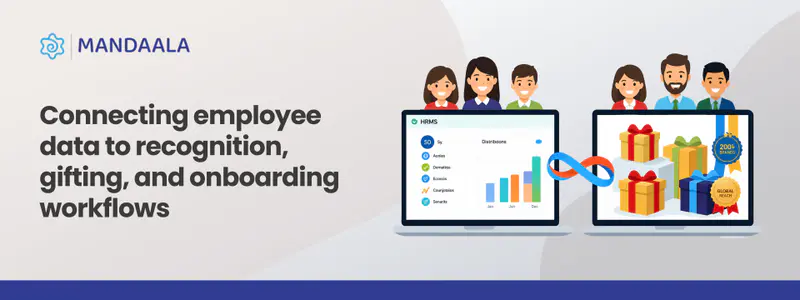
Connect the two, and the idea is pretty simple. Something happens in the HRMS, a new hire joins, someone hits a milestone, festive season rolls around, and that becomes the trigger for everything else. Nobody has to remember. Nobody has to chase. The thing just... happens.
Automated Employee Recognition Workflows: What Connected HRMS Integration Looks Like

Onboarding. A new hire shows up in the HRMS. The gifting side picks that up, checks their grade, and sorts the right welcome kit automatically. The new joiner gets a link, picks what they'd like, pops in their address. Kit arrives before Day 1. HR does precisely nothing after they've set the rules once. Redemption rates above 90% are pretty normal here, mostly because nobody's emailing the new hire asking for their t-shirt size three days before they start.
Milestones. The Five-year flag goes up in the HRMS. The employee gets a personalised link, picks something they actually want, enters their own address, done. Anywhere in India. No follow-ups, no chasing. Companies doing this see satisfaction scores around 4.8 out of 5, and honestly, it's less about the gift itself and more about the fact that it showed up on time and felt like someone actually meant it.
Festive gifting. Employee list syncs straight from the HRMS. Everyone gets a link, picks a gift, enters their address. Eight hundred people across twelve cities, all dispatched on the same timeline, with a full record of who got what. One company saved 15-20 hours of HR coordination in a single week. Fifteen to twenty hours, for something that's now basically automatic.
Same pattern every time. The data does the heavy lifting. HR sets it up once and steps back.
Where Integration Matters Most

Not all integrations are doing the same job.
Some tell the platform who the employee is. Some determine when a programme should be triggered. Others handle how employees access it or where recognition points can be spent.
1. HRMS Integration
This is usually where everything starts.
The HRMS already knows who's joined, who's completed five years, who's changed locations, and who's still with the company. Connecting it to the gifting platform means that information doesn't just sit there looking important.
Typical integration points include:
Employee Data – Designation, department, grade, reporting manager, and employment status.
Milestone Data – Joining dates, work anniversaries, service milestones, and tenure-based eligibility.
Location Data – Office locations, business units, and regional information used for programme rules and fulfilment.
Workflow Triggers – Events such as onboarding, milestone recognition, long service awards, and festive gifting.
In other words, the HRMS identifies the moment. The gifting platform does something with it.
2.SSO Integration
This one is less about recognition and more about access.
Employees already have enough passwords to remember. SSO allows them to access the recognition platform using the same credentials they use for everything else at work.
Typical integration points include:
Authentication – Employee login through existing corporate credentials.
User Provisioning – Automatic creation and removal of platform access.
Role Mapping – Access permissions based on role or organisational structure.
Security Controls – Centralised authentication and access management.
Sounds technical. Mostly translates to fewer people getting locked out.
3.Rewards & Recognition Platform Integration
Many organisations already run recognition programmes through platforms like AdvantageClub, Vantage Circle, or similar solutions.
The goal here isn't to replace those platforms. It's to connect them.
Typical integration points include:
Recognition Points – Points earned through recognition programmes.
Nominations – Peer-to-peer and manager-led recognition activity.
Reward Catalogues – Available redemption options and reward inventories.
Redemption Data – Gift selections, reward claims, and utilisation activity.
Programme Reporting – Participation, redemption, and engagement data.
That way, recognition can happen in one system and gifting can happen in another without employees feeling like they're being bounced between platforms.
HRMS Integration Case Study: India's Largest Private Bank

This bank was running onboarding kits manually across different divisions for years. Quality varied depending on which team handled it, logistics across the country were a constant headache, and employee data was moving through channels that weren't exactly secure.
They connected their HRMS to MerchTech. Now, kits are triggered automatically based on the new hire's grade, fulfilled centrally, and shipped out, no manual coordination required at all. Same problems most companies have. Sorted, by connecting two systems that should've been talking all along.
The full case study has all the details if you're curious.
What This Means Going Forward
Here's the bit that's easy to miss: this gap doesn't stay the same size. It grows with you. A 500-person company can paper over a disconnected HRMS with one diligent HR person and a good memory. At 5,000, that same gap shows up as missed milestones, inconsistent experiences across cities, and a finance team that can't tell you what recognition actually costs or returns. The problem doesn't get easier with scale. It gets louder.
So the real question for any organisation growing fast, going pan-India, or onboarding in bulk isn't "do we have a gifting platform." It's "will this still work when we're three times the size we are today." Most manual setups quietly fail that test long before anyone notices.
This is the gap MerchTech is built for, plugging into the HRMS your enterprise already runs, so a milestone turns straight into a gift the employee picks themselves, no chasing required, and no rebuild needed as you scale.
If you're working through this for your own setup, happy to show you how it works.
Mandaala is the solutions arm of PrintStop India.